
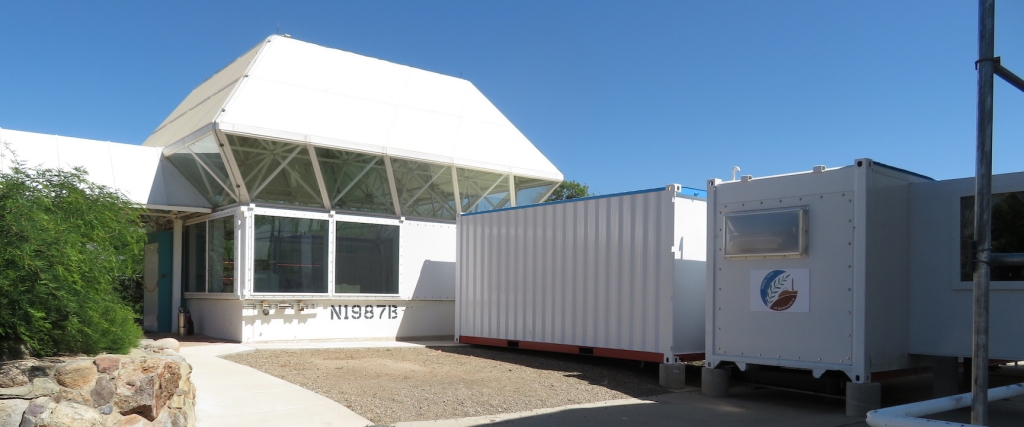
The Space Analog for the Moon and Mars (SAM) was a hermetically sealed and pressurized research facility located at the renowned University of Arizona Biosphere 2. As a research facility, SAM developed advanced systems for bioregeneration and CO2 scrubbing, a prototype surgical bay, and systems for in situ water and food recycling; a reduced gravity simulator and pressure suit exploration of an indoor, geologically accurate Mars yard. SAM provides an unparalleled environment in which to conduct a multitude of studies in mechanical and plant-based life support, plant biology, food studies, haptics and tool use while encumbered by a pressure suit; EVA, rover, and drone field exploration. As a habitat analog, SAM was a powerful environment to study the challenges of isolation and interpersonal engagement, food preparation, water use, maintenance of a complex vessel, and personal expression through writing, music, photography and film.
SAM integrated the Biosphere 2 prototype Test Module greenhouse (TM) with an adjacent engineering bay and crew quarters complete with kitchen, common area, and sleeping accommodation. The TM provides an advanced hydroponic grow environment with automated lighting, water, nutrients, humidity, and temperature control. An advanced mechanical CO2 scrubber research facility was constructed under a technology license with NASA, a terrestrial, functional copy of the unit that operates on the International Space Station today. Research into bioregenerative life support was concluded. And a fully functional airlock lead to an adjacent, geologically accurate, 3,000 sq-ft indoor Mars yard. Pressure suits, rovers, and drones can be tested over varied terrain and obstacles. A reduced gravity simulator provides the experience of exploring on foot in lunar and martian gravitational fields.
Our Philosophy | The SAM Research Station | Components | Photos | Updates